Draco Group faced an unusual challenge at Durban Gateway Terminal: remove four ageing Ship-to-Shore container cranes, each weighing close to 900 tonnes, without dragging the job out for months. Instead of dismantling them piece by piece over the five to seven months originally planned, the team engineered a far bolder solution – bring each crane down in a controlled freefall, land it exactly where intended, then dismantle it safely at ground level.
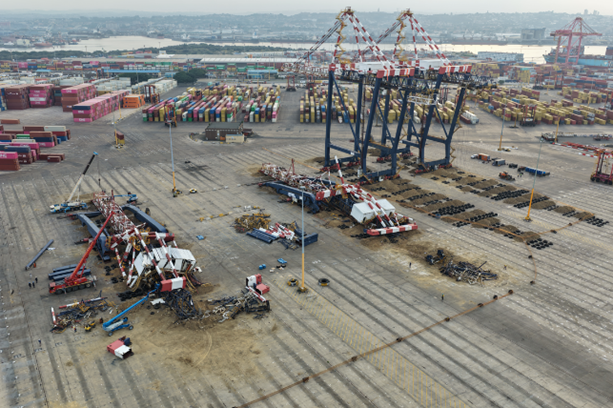
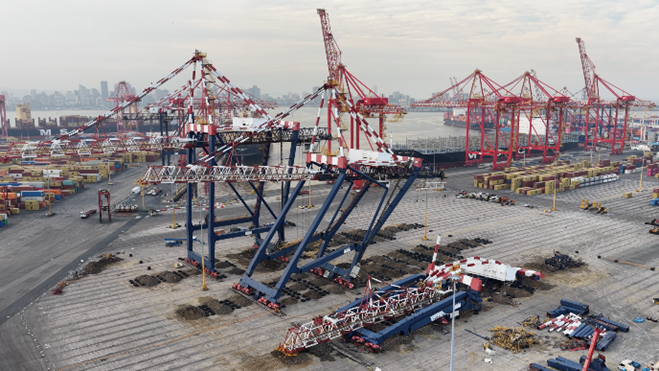
Each crane stood about 80 metres high, stretched roughly 130 metres and weighed close to 900 tonnes. Draco Group engineered a controlled toppling sequence for each one, calculating the weakening points, pulling force and landing footprint before certified rigging teams installed the pulling system. Two excavators then initiated the fall, bringing each crane down into its planned landing zone.
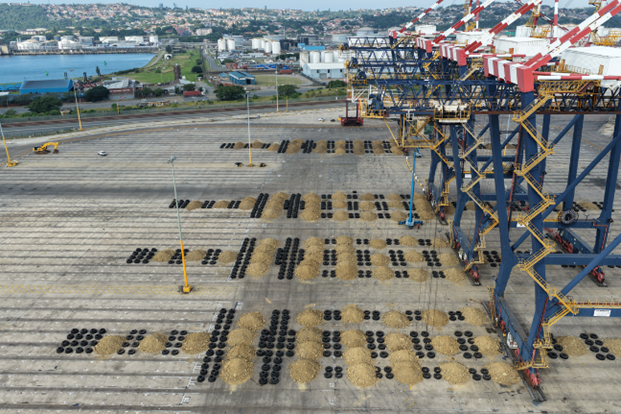
To protect the quay, buried services and stormwater infrastructure below, Draco Group built purpose-made impact mattresses from more than 4,822 tonnes of imported overburden, reinforced with discarded straddle carrier tyres to absorb the force of each landing.
During the site investigation, the team found another complication. The crane rails sat on timber sleepers and were not fixed directly to the concrete below, raising the possibility that a crane could shift sideways as it was pulled into its fall. As Durban Gateway Terminal wanted to keep the rail system for future use, Draco Group developed a temporary restraint system that kept everything firmly in place during the toppling without damaging the existing infrastructure.
All four cranes landed within their predetermined impact zones. There were no injuries, no damage to the quay, rail system, buried services or other terminal infrastructure, and no environmental incidents.
Once on the ground, the cranes were cut into transportable sections. Around 3,450 tonnes of ferrous steel were recovered, with 98% of material generated by the project recycled. The impact mattresses were later removed and the overburden reused elsewhere.
Most significantly, the controlled freefall method reduced the programme from an estimated five to seven months to ten weeks while removing much of the prolonged high-risk work at height.
Four cranes. Four controlled falls. Zero injuries and zero infrastructure damage. The project showed how specialist demolition engineering can challenge a conventional brief and deliver a safer, faster and more practical result.
To the best of Draco Group’s research, controlled freefall demolition of Ship-to-Shore cranes remains exceptionally rare internationally, and this is believed to be the first project of its kind completed anywhere in the Southern Hemisphere or on the African continent. It stands as proof of what specialist demolition engineering can achieve when a contractor is prepared to challenge conventional thinking: a safer, faster, more economical and more environmentally responsible outcome, and a new benchmark for how heavy industrial structures can be brought down at the end of their working lives.