Fire is a material operational and safety risk across South Africa’s mining sector. The country’s latest mandatory fire-prevention guideline recorded 584 reported mine-fire incidents between 2019 and 2023[1], with mobile machinery, conveyor belts, electrical infrastructure, hot work and spontaneous combustion among the identified causes.
For mining companies, the challenge is not simply to purchase “flameproof” equipment, but to ensure that every item is selected, certified, operated and maintained for the exact environment in which it will work.
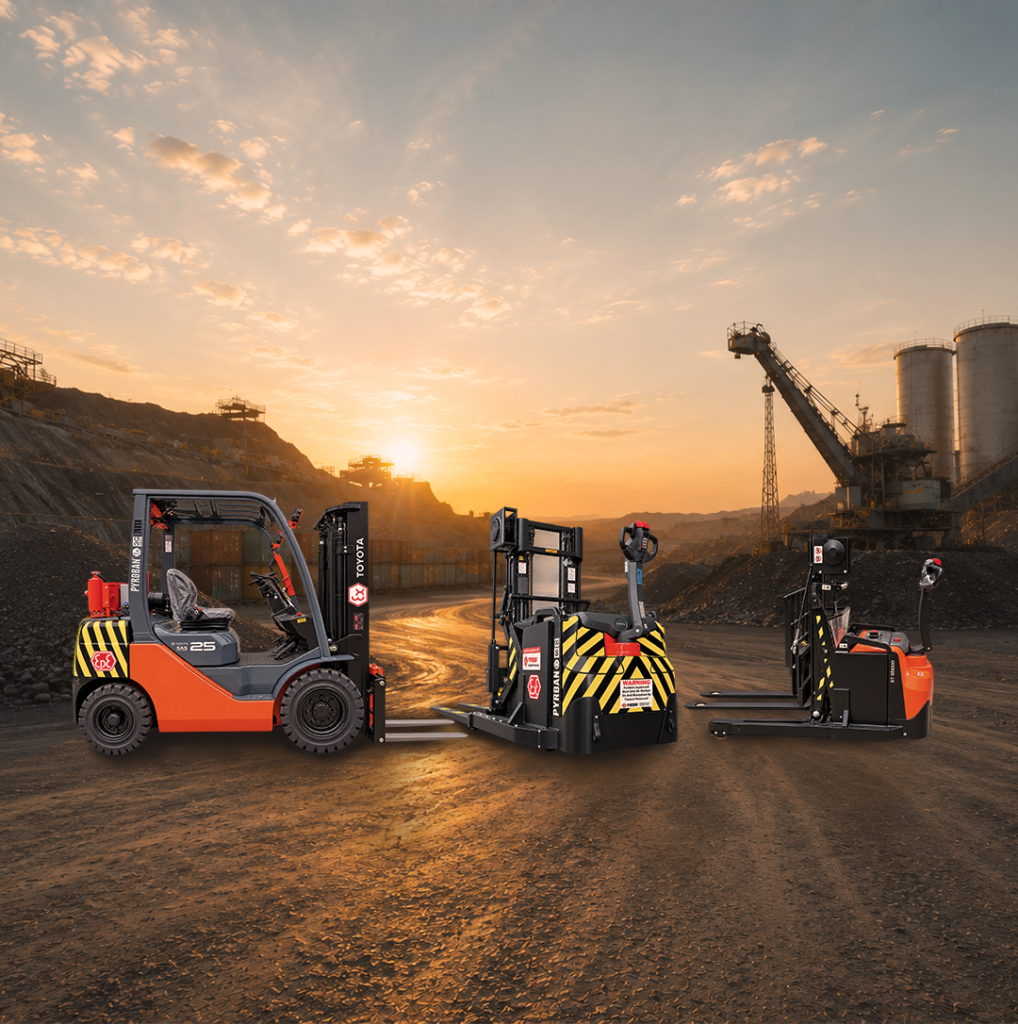
Refilwe Molapo, General Manager of Toyota Material Handling (TMH), a division of CFAO Equipment, says every mine presents different risks. “Explosions are typically caused by the accumulation of flammable gases and/or combustible dust that, when mixed with air and exposed to an ignition source, ignite.”
Across both underground and surface operations, fire risks can originate from fuel, lubricants, electrical faults, hot engine and exhaust surfaces, welding, cutting, conveyor systems and mobile machinery. Underground incidents are particularly dangerous because smoke and toxic fumes accumulate in confined spaces where ventilation and escape routes may be limited.
He stresses that mines are not the only operations that benefit from explosion- and fire-proof forklifts. “Industries that deal in flammable items such as the FMCG industry and manufacturers and distributors of fragrances, for example, also need to consider safe equipment.”
Ernest Makhoshi, Utilities Specialist, Taste & Wellbeing at Givaudan says the TMH equipment – notably the ATEX stacker – the company uses demonstrates excellent compliance with safety standards and regulations, particularly those applicable to the plant, where flammable materials are handled.
“We are especially impressed with the machine’s safety features and interlock systems, which provide a high level of protection and contribute significantly to maintaining a safe working environment.”
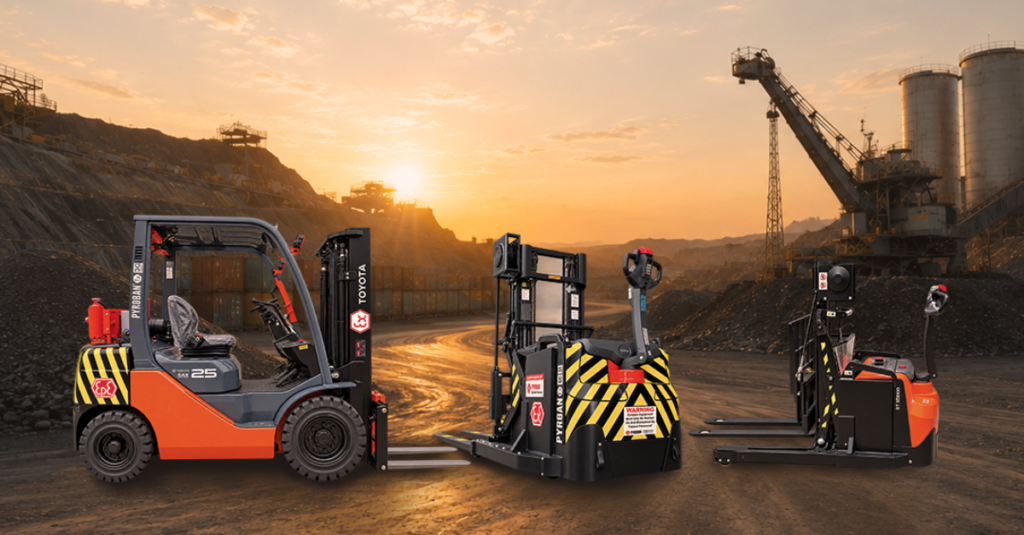
Molapo says while specialised forklifts reduce the likelihood of becoming an ignition source by controlling hazards such as sparks, static electricity, electrical faults, hot surfaces and fuel-system risks, the equipment alone cannot eliminate risk.
“A forklift must form part of a broader safety system that includes ventilation, gas monitoring, dust control, fire detection, emergency preparedness, competent operators and mine-specific codes of practice. It must also be certified for the exact hazardous-area classification in which it will operate.”
Safety and productivity should not be viewed as competing priorities. Equipment failures, fires and unplanned shutdowns place people at risk while disrupting production, increasing costs and affecting customer service. The goal is to engineer risk out of operations without compromising performance.
“The equipment must meet hazardous-area requirements while still delivering the required lifting capacity, safe operation, good visibility and reliable performance throughout its duty cycle,” says Molapo.
Beyond explosion protection, CFAO Equipment offers technologies designed to improve safety and operational visibility. Toyota’s System of Active Stability helps manage stability risks on applicable models, while Toyota I_Site provides fleet data to support equipment utilisation, maintenance planning and downtime management. Molapo notes that technology is most effective when supported by proper operator training and sound equipment selection.
Customer expectations have also evolved. Rather than buying standalone equipment, mining companies increasingly seek complete operating solutions that address maintenance, technical support, data availability and total lifecycle costs.
Molapo notes that in higher-risk applications, documentation and traceability are becoming increasingly important. “Customers need clarity on hazardous-area classification, equipment certification, operating conditions, inspection requirements and which components may or may not be modified.”
Operational visibility is another growing priority. Fleet managers want real-time information on equipment utilisation, operating hours, impact events and maintenance requirements. Fleet management systems such as Toyota I_Site help improve productivity while reducing downtime.
Sustainability is also influencing equipment selection, with growing interest in electric forklifts and lithium-ion technology. However, Molapo cautions that electric equipment is not automatically explosion-safe. Battery systems, charging infrastructure and the complete equipment must still be assessed against the operating environment and relevant certification requirements.
When selecting equipment, Molapo says the starting point should always be the mine’s risk assessment rather than a product catalogue. “The customer and supplier must first establish where the machine will operate, which gases, vapours or combustible dusts may be present, how frequently they occur and how the area has been classified.”
The next step is verifying that the complete machine is certified for that environment. Equipment certificates, markings, gas or dust groups, temperature limits and operating restrictions must all align with the mine’s hazardous-area classification.
South African mining guidance references SANS 10108 and the SANS 60079 family for hazardous atmospheres, while SANS 868 applies to compression-ignition engine systems and equipment operating in explosive gas or dust environments.
Operational requirements remain equally important. Mines should evaluate lifting capacity, mast height, gradients, floor conditions, braking performance, tyres, visibility, lighting, operator protection, ventilation and expected operating hours. Maintainability is equally critical. Unauthorised repairs or modifications can compromise the integrity of an explosion-protection system, making competent servicing and certified replacement parts essential.
“The equipment is only one part of the safety solution. Its long-term performance depends on operator training, daily inspections, planned maintenance, technical competence and the availability of the correct parts,” notes Molapo.
Toyota Material Handling supports customers through operator licensing and certification, novice and refresher programmes, product training and on-site instruction. Its aftermarket services include maintenance, genuine parts, load testing, engineering support, field service, rentals and Toyota I_Site fleet management.
Looking ahead, Molapo believes connectivity will drive the next phase of mining equipment development. “Telematics already enables fleet owners to monitor utilisation, servicing and downtime, and as data quality improves, maintenance will increasingly be based on actual machine condition rather than fixed schedules. Electrification will also continue to expand where mines seek to reduce emissions, provided solutions meet operational requirements and hazardous-area certification.
“Over the next decade, the winning model will be a connected ecosystem where equipment, operators, technicians and customers share reliable information to improve safety, maintenance planning and equipment utilisation without compromising compliance,” concludes Molapo.